Reasoning is one of the section of SBI PO exam along with Quantitative Aptitude and Reading comprehension.
Practice tests or Mock tests help aspirants to prepare for the exams.
Reasoning is the ability of the candidate to assess things rationally by applying logic and common sense based on new or existing information when making a decision or solving a problem.
Total number of Questions: 100
Total number Quantitative Aptitude (QA) Questions: 35
Total number Reasoning (RE) Questions: 35
Total number Comprehension (COMP) Questions: 30
Maximum Time: 20 : 00 (Minutes : Seconds) per section
Note: Not allowed to change section once selected.
Directions (for questions 1 to 3): In each question below are given two statements numbered I and II. You have to take the two given statements as true even if they seem to be at variance with commonly known facts. Read all the conclusions and then decide which of the given conclusions logically follow from the given statements, disregarding commonly known facts.
Statement I: All veggies have gravy.
Statement II: All lunch has veggies.
Options:
Option (a): All lunch has gravy.
Option (b): Some gravy have lunch.
Option (c): All gravy have veggies.
Option (d): All (a), (b) and (c).
Option (e): None of these.
Directions (for questions 1 to 3): In each question below are given two statements numbered I and II. You have to take the two given statements as true even if they seem to be at variance with commonly known facts. Read all the conclusions and then decide which of the given conclusions logically follow from the given statements, disregarding commonly known facts.
Statement I: Steven Spielberg is a good director.
Statement II: Directors are intelligent.
Options:
Option (a): All intelligent are directors.
Option (b): Steven Spielberg is intelligent.
Option (c): All directors are Steven Spielberg.
Option (d): Both (a) and (c).
Option (e): None of these.
Directions (for questions 1 to 3): In each question below are given two statements numbered I and II. You have to take the two given statements as true even if they seem to be at variance with commonly known facts. Read all the conclusions and then decide which of the given conclusions logically follow from the given statements, disregarding commonly known facts.
Statement I: Some Whites are Black.
Statement II: Grey is Black.
Options:
Option (a): Some white are grey.
Option (b): Some black are grey.
Option (c): All grey are white.
Option (d): All grey are black.
Option (e): None of the above follows.
Directions (for questions 4 and 5): Two/Three/Four statements are given in each of the following questions, followed by three/four conclusions numbered I, II, III and IV. You have to take the given statements to be true even, if they seem to be at variance from commonly known facts. Read all the conclusions and then decide which of the given conclusions logically follows from the given statements disregarding commonly known facts.
Statement I: Some Decades are Centuries.
Statement II: All Millennium are Centuries.
Conclusion I: Some Millenniums are Decades.
Conclusion II: Some Centuries are Decades.
Conclusion III: No Millennium is a Decade.
Options:
Option (a): Conclusions I and II follow.
Option (b): Conclusions I and III follow.
Option (c): Either I or III and II follows.
Option (d): Conclusions II follow.
Option (e): None of the above follows.
Directions (for questions 4 and 5): Two/Three/Four statements are given in each of the following questions, followed by three/four conclusions numbered I, II, III and IV. You have to take the given statements to be true even, if they seem to be at variance from commonly known facts. Read all the conclusions and then decide which of the given conclusions logically follows from the given statements disregarding commonly known facts.
Statement I: Some philosophers are fools.
Statement II: Some fools are illiterates.
Statement III: Some philosophers are illiterates.
Statement IV: Aristotle was a great Greek philosopher.
Conclusion I: Aristotle was an illiterate.
Conclusion II: All illiterates are philosophers.
Conclusion III: All illiterates are fools.
Conclusion IV: Aristotle was a fools.
Options:
Option (a): Conclusions I and II follow.
Option (b): Conclusions I and III follow.
Option (c): Either I or III and II follows.
Option (d): All the above follows.
Option (e): None of the conclusions follow.
Directions (for questions 6 to 9): Study the following information carefully and answer the given questions. A word and number arrangement machine when given an input line of words and numbers rearranges them following a particular rule in each step. The following is an illustration of input and rearrangement.
Input: red pink 22 32 87 gold 44 tan
Step I: 22 red pink 32 87 gold 44 tan
Step II: 22 tan red pink 32 87 gold 44
Step III: 22 tan 32 red pink 87 gold 44
Step IV: 22 tan 32 red 44 pink 87 gold
Step IV is the last step of the rearrangement.
Step III of an input is 15 yes 24 80 today never go 59, which of the following will definitely be the input?
Options:
Option (a): 24 80 today never go 59 15 yes.
Option (b): 24 80 today yes never go 59 15.
Option (c): 24 15 yes 80 today never go 59.
Option (d): 24 yes 15 today 80 never go 59.
Option (e): cannot be determined.
Directions (for questions 6 to 9): Study the following information carefully and answer the given questions. A word and number arrangement machine when given an input line of words and numbers rearranges them following a particular rule in each step. The following is an illustration of input and rearrangement.
Input: red pink 22 32 87 gold 44 tan
Step I: 22 red pink 32 87 gold 44 tan
Step II: 22 tan red pink 32 87 gold 44
Step III: 22 tan 32 red pink 87 gold 44
Step IV: 22 tan 32 red 44 pink 87 gold
Step IV is the last step of the rearrangement.
Input man 79 over 63 like 43 joy 15. How many steps will be required to complete the rearrangement?
Options:
Option (a): Five
Option (b): Four
Option (c): Six
Option (d): Eight
Option (e): Seven
Directions (for questions 6 to 9): Study the following information carefully and answer the given questions. A word and number arrangement machine when given an input line of words and numbers rearranges them following a particular rule in each step. The following is an illustration of input and rearrangement.
Input: red pink 22 32 87 gold 44 tan
Step I: 22 red pink 32 87 gold 44 tan
Step II: 22 tan red pink 32 87 gold 44
Step III: 22 tan 32 red pink 87 gold 44
Step IV: 22 tan 32 red 44 pink 87 gold
Step IV is the last step of the rearrangement.
Step III of an Input 18 tower 38 basket 82 76 hall new. Which of the following will be step VI?
Options:
Option (a): 38 hall 18 tower 76 new basket 82.
Option (b): 18 hall 38 tower 76 new basket 82.
Option (c): 18 tower 38 hall 76 new basket 82.
Option (d): 18 tower 38 new 76 hall basket 82.
Option (e): 18 new tower 38 hall 76 basket 82.
Directions (for questions 6 to 9): Study the following information carefully and answer the given questions. A word and number arrangement machine when given an input line of words and numbers rearranges them following a particular rule in each step. The following is an illustration of input and rearrangement.
Input: red pink 22 32 87 gold 44 tan
Step I: 22 red pink 32 87 gold 44 tan
Step II: 22 tan red pink 32 87 gold 44
Step III: 22 tan 32 red pink 87 gold 44
Step IV: 22 tan 32 red 44 pink 87 gold
Step IV is the last step of the rearrangement.
Step III of an Input 32 style 48 94 join for 81 home. How many steps will be required to complete the rearrangement?
Options:
Option (a): Three
Option (b): Two
Option (c): One
Option (d): Four
Option (e): Five
Directions (10-14): Study the information carefully and answer the questions given below.
Eight scientists A, B, C, D, E, F, G, and H went for research on four different months, of two different dates i.e. 17th and 24th. Those four different months are January, March, April, and May. All information is not necessarily in the same order. B went for research in April month. F went for research on an odd number date. More than one scientist went between C and D. Three scientists went between B and E. Equal number of scientists went after E and before C. One scientist went between A and H. Equal number of scientists went after G and before F. A went for research on one of the months, but not in the same month of B. D did not go on an odd number date.
Who among the following scientists went on 17th January for research?
Options:
Option (a): G
Option (b): E
Option (c): D
Option (d): B
Option (e): None of these.
Directions (10-14): Study the information carefully and answer the questions given below.
Eight scientists A, B, C, D, E, F, G, and H went for research on four different months, of two different dates i.e. 17th and 24th. Those four different months are January, March, April, and May. All information is not necessarily in the same order. B went for research in April month. F went for research on an odd number date. More than one scientist went between C and D. Three scientists went between B and E. Equal number of scientists went after E and before C. One scientist went between A and H. Equal number of scientists went after G and before F. A went for research on one of the months, but not in the same month of B. D did not go on an odd number date.
How many scientists went between G and D?
Options:
Option (a): Three
Option (b): One
Option (c): Four
Option (d): Five
Option (e): None of these.
Directions (10-14): Study the information carefully and answer the questions given below.
Eight scientists A, B, C, D, E, F, G, and H went for research on four different months, of two different dates i.e. 17th and 24th. Those four different months are January, March, April, and May. All information is not necessarily in the same order. B went for research in April month. F went for research on an odd number date. More than one scientist went between C and D. Three scientists went between B and E. Equal number of scientists went after E and before C. One scientist went between A and H. Equal number of scientists went after G and before F. A went for research on one of the months, but not in the same month of B. D did not go on an odd number date.
Who among the following scientists went on even number date of the month which has even number of days?
Options:
Option (a): H
Option (b): B
Option (c): F
Option (d): G
Option (e): None of these.
Directions (10-14): Study the information carefully and answer the questions given below.
Eight scientists A, B, C, D, E, F, G, and H went for research on four different months, of two different dates i.e. 17th and 24th. Those four different months are January, March, April, and May. All information is not necessarily in the same order. B went for research in April month. F went for research on an odd number date. More than one scientist went between C and D. Three scientists went between B and E. Equal number of scientists went after E and before C. One scientist went between A and H. Equal number of scientists went after G and before F. A went for research on one of the months, but not in the same month of B. D did not go on an odd number date.
How many scientists went before D?
Options:
Option (a): Three
Option (b): Two
Option (c): One
Option (d): Four
Option (e): Five
Directions (10-14): Study the information carefully and answer the questions given below.
Eight scientists A, B, C, D, E, F, G, and H went for research on four different months, of two different dates i.e. 17th and 24th. Those four different months are January, March, April, and May. All information is not necessarily in the same order. B went for research in April month. F went for research on an odd number date. More than one scientist went between C and D. Three scientists went between B and E. Equal number of scientists went after E and before C. One scientist went between A and H. Equal number of scientists went after G and before F. A went for research on one of the months, but not in the same month of B. D did not go on an odd number date.
Which of the following combination is true?
Options:
Option (a): 17th March-A
Option (b): 17th May-B
Option (c): 17th April-G
Option (d): 24th April-C
Option (e): None of these.
Directions (for questions 15 to 18): Choose the best alternatives as the answer.
A cricket always has ........
Options:
Option (a): Pitch.
Option (b): Gloves.
Option (c): Pads.
Option (d): Bat.
Option (e): None of these.
Directions (for questions 15 to 18): Choose the best alternatives as the answer.
A school always has ........
Options:
Option (a): Library.
Option (b): Teacher.
Option (c): Building.
Option (d): Classes.
Option (e): None of these.
Directions (for questions 15 to 18): Choose the best alternatives as the answer.
What always Worries?
Options:
Option (a): Difficulty.
Option (b): Poignancy.
Option (c): Unrest.
Option (d): Non-Co-operation.
Option (e): None of these.
Directions (for questions 15 to 18): Choose the best alternatives as the answer.
Milk always contains ..........
Options:
Option (a): Sugar.
Option (b): Fat.
Option (c): Water.
Option (d): Calcium.
Option (e): None of these.
Raja is son of Aman's father's sister. Sachin is son of Gauri, who is the mother of Gaurav and grandmother of Aman. Aryan is the father of Tanya and grandfather of Raja. Gauri is the wife of Aryan. How is Raja related to Gauri?
Options:
Option (a): Grandson.
Option (b): Son.
Option (c): Daughter.
Option (d): Friday.
Option (e): Son - in - Law.
The Republic Day of India was celebrated on Wednesday in the year 2022. On which day, will it be celebrated in the year 2023?
Options:
Option (a): Monday.
Option (b): Tuesday.
Option (c): Thursday.
Option (d): Friday.
Option (e): Saturday.
In a code language, 'ORGANISATION' is written as 'CBDWLQJWYQCL' and 'OPERATION' is written as 'CXFBWYQCL'. How would 'SEPARATION' be coded?
Options:
Option (a): JFXWBWYQCL
Option (b): JFCWBQLFCL
Option (c): QCLJFXWBWY
Option (d): WBWJFXYQCL
Option (e): None of these.
Peacock : India :: Bear : ________
Options:
Option (a): America
Option (b): Australia
Option (c): Russia
Option (d): England
Option (e): China
Pick the odd pair?
Options:
Option (a): Lion - Roar
Option (b): Snake - Hiss
Option (c): Bees - Hum
Option (d): Frog - Bleat
Option (e): Dog - Bark
How many such pairs of letters are there in the word 'PREAMBLE', each of which has as many letters between them as in the English alphabet
Options:
Option (a): None
Option (b): One
Option (c): Two
Option (d): Three
Option (e): More than three.
How many meaningful English words can be formed with the third, the fifth, the seventh and the ninth letters of the word 'DOWNGRADED' once in each word?
Options:
Option (a): None
Option (b): One
Option (c): Two
Option (d): Three
Option (e): Four
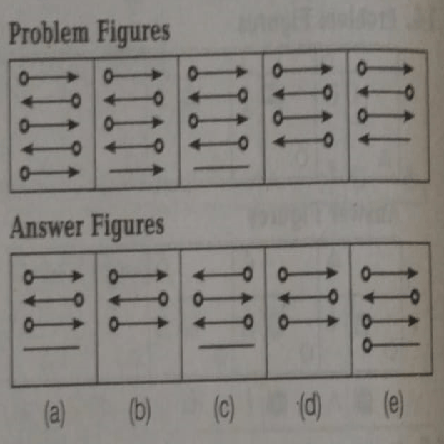
Directions for Questions (26 to 28): Based on the sequence, which figure would come next to the right?
Options:
Option (a): a
Option (b): b
Option (c): c
Option (d): d
Option (e): e
Directions for Questions (27 to 29): Based on the sequence, which figure would come next to the right?
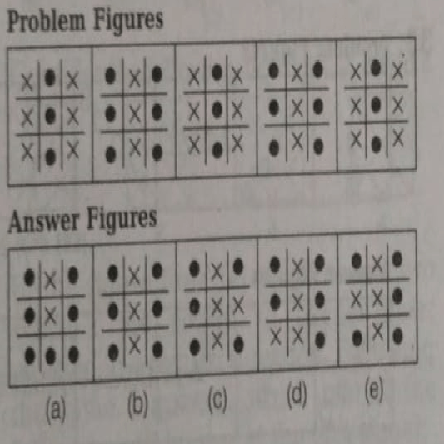
Options:
Option (a): a
Option (b): b
Option (c): c
Option (d): d
Option (e): e
Directions for Questions (26 to 28): Based on the sequence, which figure would come next to the right?
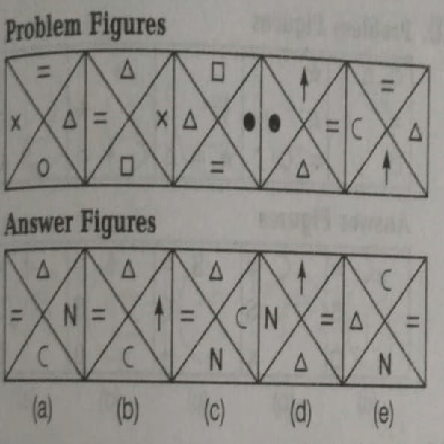
Options:
Option (a): a
Option (b): b
Option (c): c
Option (d): d
Option (e): e
Directions for Questions (29 to 32): Based on the first pair relationship. Which figure would replace the question mark (?).
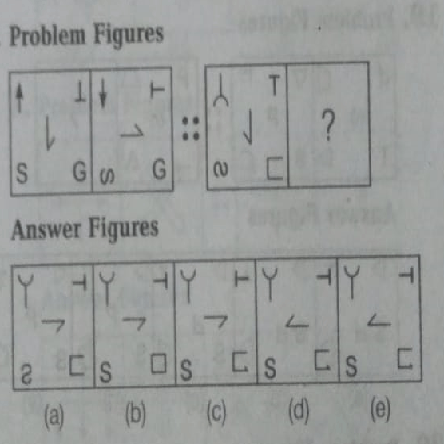
Options:
Option (a): a
Option (b): b
Option (c): c
Option (d): d
Option (e): e
Directions for Questions (29 to 32): Based on the first pair relationship. Which figure would replace the question mark (?).
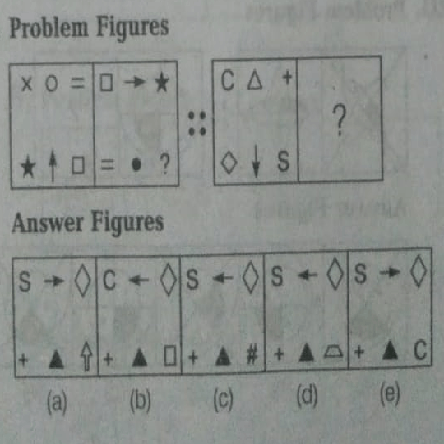
Options:
Option (a): a
Option (b): b
Option (c): c
Option (d): d
Option (e): e
Directions for Questions (29 to 32): Based on the first pair relationship. Which figure would replace the question mark (?)
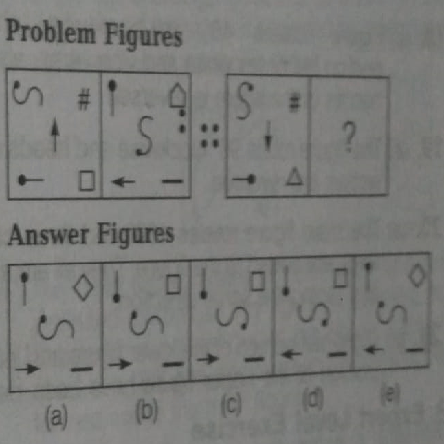
Options:
Option (a): a
Option (b): b
Option (c): c
Option (d): d
Option (e): e
Directions for Questions (29 to 32): Based on the first pair relationship. Which figure would replace the question mark (?)
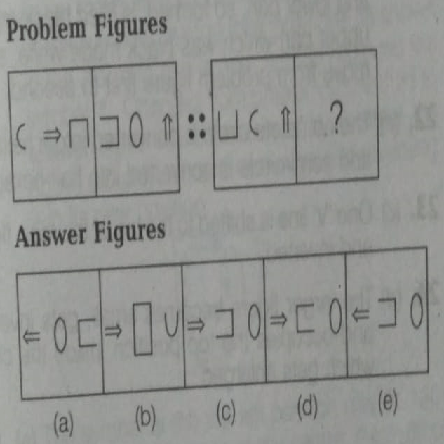
Options:
Option (a): a
Option (b): b
Option (c): c
Option (d): d
Option (e): e
How many triangles are there in the following figure?
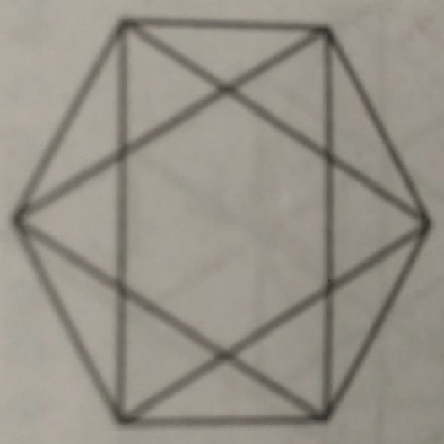
Options:
Option (a): a
Option (b): b
Option (c): c
Option (d): d
Option (e): e
Directions for Questions (34 and 35): Pick the odd figure out.
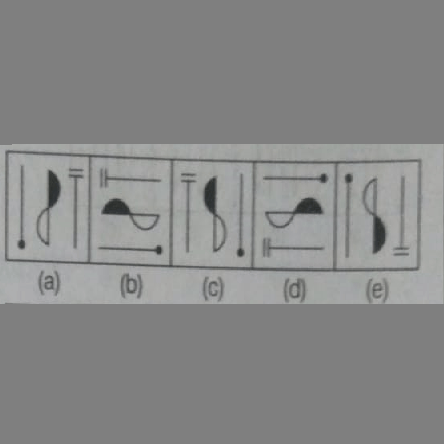
Options:
Option (a): a
Option (b): b
Option (c): c
Option (d): d
Option (e): e
Directions for Questions (34 and 35): Pick the odd figure out.
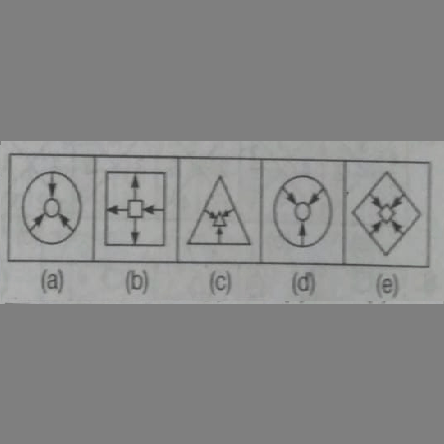
Options:
Option (a): a
Option (b): b
Option (c): c
Option (d): d
Option (e): e

Created with
Web Design Program